
The Insulin Resistance Epidemic: The Hidden Driver Behind Obesity, Prediabetes, and Type 2 Diabetes

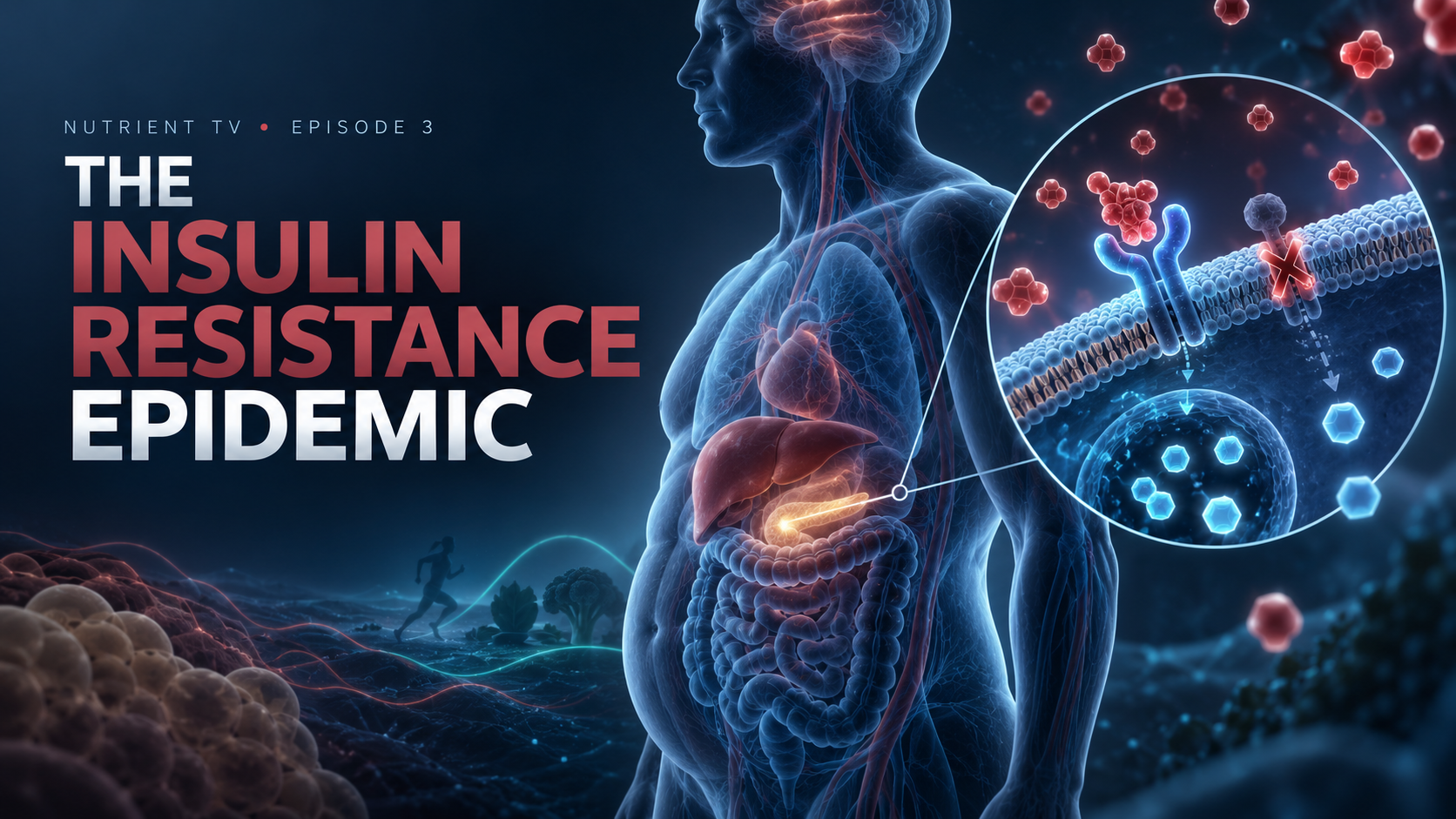
America is facing an insulin resistance epidemic.
Not just an obesity epidemic. Not just a type 2 diabetes epidemic. Not just a belly-fat problem. Underneath much of the modern chronic disease crisis is a body that can no longer handle carbohydrates the way it once did.
That is the central argument of Nutrient TV Episode 3.
For years, people have been told to focus on the number on the scale. Eat less. Move more. Take another prescription. But if we want to understand obesity and type 2 diabetes, we have to understand insulin.
Insulin: The Storage Hormone
Insulin is not evil. Insulin is necessary.
When you eat carbohydrates, those carbohydrates break down into glucose. Glucose enters the bloodstream. The pancreas releases insulin to help move that glucose into the cells.
That is normal.
But when this happens too often, too intensely, for too many years, the body can become resistant to insulin’s signal.
Imagine someone knocking on your door all day long. At first, you answer. Then you get tired of it. Eventually, you stop responding.
That is the simple Nutrient TV explanation of insulin resistance.
The body keeps producing insulin, but the cells stop listening as well. So the pancreas produces more. Then more. Then more.
Blood sugar may look normal for years because insulin is working overtime. But underneath, the body is struggling.
Carb Toxicity and Fat Storage
Too much sugar and too many ultra-processed carbohydrates, too often, can drive insulin higher and higher. When insulin stays elevated, the body becomes very good at storing fuel as fat.
This is why the conversation cannot stop with calories.
Food composition matters. Blood sugar matters. Insulin matters. The food environment matters.
A hundred years ago, one of the great threats to human life was famine. Today, in modern America, one of the great threats is obesity and the multiple chronic diseases that follow.
Many metabolic physicians and low-carb researchers describe type 2 diabetes through the lens of carbohydrate intolerance. Nutrient TV asks a straightforward question: if a person’s body cannot properly handle high carbohydrate loads, why would the only answer be to continue the same food environment and simply chase the numbers with medication?
The Root Problem
Insulin resistance is a fuel problem.
A carbohydrate problem.
A blood sugar problem.
A metabolic flexibility problem.
And for many people, a lifestyle problem.
The answer cannot only be another drug.
Food has to be part of the answer. Sugar has to be part of the answer. Carbohydrates have to be part of the answer. Protein quality has to be part of the answer. Fat quality has to be part of the answer.
The Body Is a Hybrid Engine
The human body can run on glucose, and it can run on ketones.
When someone is eating high carbohydrates all day, the body keeps reaching for glucose. Sugar, refined carbohydrates, ultra-processed carbs, snack foods, and constant eating keep glucose and insulin at the center of the fuel system.
When carbohydrates are reduced, the body has the ability to shift. It can begin producing ketones. It can begin using fat as fuel.
That is nutritional ketosis.
Nutrient TV describes nutritional ketosis as a natural metabolic state that mimics some of the effects of fasting without starvation.
Starvation ketosis happens when food is unavailable and the body is forced to survive. Nutritional ketosis happens when the diet is structured to reduce carbohydrates, use fat intelligently, and support ketone production while still feeding the body.
Nutritional ketosis should not be confused with ketoacidosis. Ketoacidosis is a dangerous medical condition, primarily a concern for type 1 diabetics and certain medical situations involving impaired insulin regulation.
Muscle Matters
The insulin resistance conversation is not complete without muscle.
Muscle matters. Strength matters. Movement matters. Walking matters. Resistance training matters.
A person does not simply need a smaller body. They need a healthier body.
That is especially important as we age. Muscle supports strength, balance, mobility, independence, and the body’s ability to use fuel.
Nutrition Ownership
Nutrient TV’s larger message is nutrition ownership.
A person struggling with weight, cravings, energy crashes, belly fat, or blood sugar concerns needs more than another gimmick. They need structure.
Control the carbohydrates. Improve the food environment. Preserve muscle. Eat real food. Use healthy fats intelligently. Give the body an opportunity to become metabolically flexible.
The future of health cannot be built only on appetite suppression and lifelong prescriptions.
We need nutrition.
We need muscle.
We need discipline.
We need faith.
We need metabolic truth.
FAQs
What is insulin resistance?
Insulin resistance is a state in which the body’s cells do not respond to insulin as effectively, causing the pancreas to produce more insulin to manage blood glucose.
Why does Nutrient TV focus on carbohydrates?
Episode 3 argues that sugar, refined starches, ultra-processed carbohydrates, and constant high-carbohydrate eating are central to the modern insulin-resistance problem.
Why does muscle matter?
Muscle is part of the body’s fuel system and is essential for strength, body composition, healthy aging, and independence.
Is nutritional ketosis the same as ketoacidosis?
No. Episode 3 clearly distinguishes nutritional ketosis from diabetic ketoacidosis.
What if I am taking medication?
Episode 3 states: if you are on medication, work with your doctor. Do not stop medication because of a television show.
Alan C. North
Sports Nutritionist, Nutraceutical Formulator & Nutrition Advocate
Alan C. North is a leading voice in clinical health media, specializing in the intersection of metabolic biochemistry and human performance. With over 15 years in the field, he bridges the gap between complex peer-reviewed research and actionable health broadcast journalism.