
How America Was Taught to Fear Fat:The Hidden Nutrition Story That Changed Everything

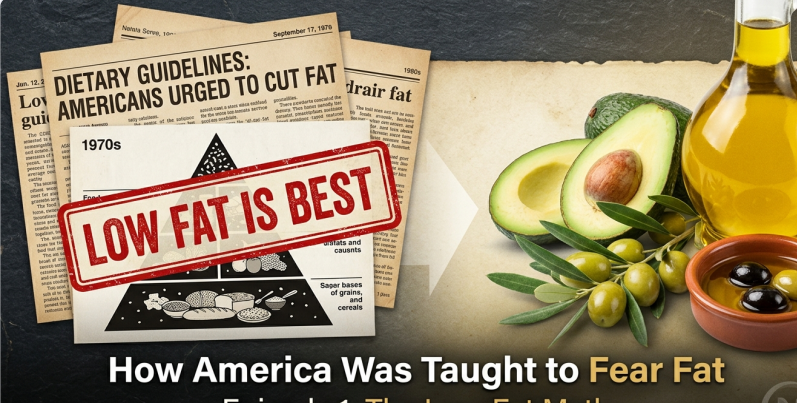
How the low-fat era reshaped American nutrition – and why today’s conversation increasingly centers on food quality, insulin resistance, and metabolic health.
KEY TAKEAWAYS
- For decades, millions of Americans believed one simple message: Fat was the enemy.
- A single nutrition claim on the front of a package does not necessarily reflect the overall quality of the
food inside. - Rather than focusing on one nutrient, today’s discussions often emphasize the broader dietary
pattern. - Understanding that history helps us ask better questions – and make more informed decisions about
our health.
Hidden Nutrition Story That Changed Everything
For decades, millions of Americans believed one simple message: Fat was the enemy. Butter disappeared from kitchen tables. Eggs became controversial. Whole milk gave way to skim milk.
Restaurants proudly advertised “low-fat” meals. Grocery stores filled with thousands of products carrying one magical marketing phrase: LOW FAT The idea seemed logical. If fat contains more calories per gram than carbohydrates or protein, then eating less fat should naturally make people leaner and healthier.
Yet something unexpected happened. America followed this advice while obesity, type 2 diabetes, metabolic syndrome, and chronic disease continued to rise. Episode 1 of Nutrient TV explores this history, asking whether the public conversation became too focused on dietary fat while overlooking other important aspects of nutrition and metabolism.
Today, nutrition researchers continue to debate which dietary patterns work best, but there is broad agreement that food quality, overall dietary patterns, and lifestyle matter more than simply labeling one nutrient as “good” or “bad.” This article examines how the fear of fat developed, why it became so influential, and why modern conversations increasingly include insulin resistance, ultra-processed foods, and metabolic health.
A Nation Looking for Answers
During the middle of the twentieth century, heart disease became one of America’s leading causes of death. Researchers, physicians, and policymakers searched for explanations. They asked difficult questions. Why were heart attacks increasing?
Could nutrition play a role? How could lives be saved? These were important scientific questions, and many researchers sincerely hoped their work would improve public health. As research evolved, one idea gained extraordinary influence:
Dietary saturated fat increased cholesterol, and higher cholesterol increased heart disease risk. While science was still developing, simplified public messages soon emerged. The result was straightforward advice: Eat less fat.
Eat less saturated fat. Avoid cholesterol. Choose lean meats. Replace butter with margarine. Drink skim milk. Those recommendations became deeply embedded in American culture.
How the Low-Fat Era Changed America
Once dietary guidelines, media messaging, and food manufacturers aligned, the transformation happened quickly. Schools served low-fat milk. Hospitals replaced butter with margarine. Food companies reformulated products. Supermarkets created entire sections devoted to reduced-fat foods. Consumers believed they were making healthier choices simply by selecting products labeled “low fat.”
Unfortunately, removing fat often created another problem. Food manufacturers still needed products to taste good. Many reduced-fat foods relied on:
Added sugars Refined starches Flavor enhancers Artificial ingredients Highly processed grains Fat disappeared. Processing increased. The label looked healthier. The ingredient list often became longer.
When Marketing Became More Powerful Than Nutrition
Food companies quickly realized that “low fat” sold products.
Entire product lines appeared: Low-fat yogurt Low-fat cookies Low-fat crackers Low-fat frozen dinners Low-fat snack cakes Low-fat cereals Many contained significant amounts of added sugar. Consumers rarely noticed because the focus remained on fat rather than the overall nutritional profile.
This illustrates an important lesson: A single nutrition claim on the front of a package does not necessarily reflect the overall quality of the food inside.
Did Americans Become Healthier?
This question continues to generate discussion. Although many factors influence public health-including physical activity, smoking, sleep, socioeconomic conditions, healthcare access, and food environments-rates of obesity and type 2 diabetes increased substantially over the same decades that low-fat messaging became widespread.
That observation does not prove that low-fat advice alone caused these changes. However, it has prompted researchers to examine additional factors, including: Increased consumption of ultra-processed foods Larger portion sizes Higher intake of refined carbohydrates Sugar-sweetened beverages Frequent snacking Sedentary lifestyles Rather than focusing on one nutrient, today’s discussions often emphasize the broader dietary pattern.
The Rise of Ultra-Processed Foods
Modern supermarkets contain thousands of packaged foods designed for convenience. Many are:
Highly refined Shelf stable Hyper-palatable Easy to overeat Research increasingly suggests that diets high in ultra-processed foods are associated with poorer health outcomes.
This does not mean every packaged food is unhealthy. Instead, it highlights the importance of considering: Ingredient quality Fiber Protein Micronutrients Added sugars Degree of processing Whole foods generally provide a nutritional package that highly processed alternatives often cannot fully replicate.
Understanding Insulin Resistance
One of the major themes discussed in Episode 1 is insulin resistance. Insulin is a hormone that helps move glucose from the bloodstream into cells. Over time, some people develop reduced sensitivity to insulin. When that happens:
The pancreas produces more insulin. Blood sugar regulation becomes more difficult. Fat storage may increase. Risk for prediabetes and type 2 diabetes rises. Insulin resistance is influenced by many factors, including: Genetics Body weight Physical inactivity Sleep Chronic stress Diet quality Because insulin plays such a central role in metabolism, many clinicians now emphasize improving insulin sensitivity through comprehensive lifestyle changes rather than focusing exclusively on dietary fat.
Why Healthy Fats Matter
One of the biggest shifts in modern nutrition is recognizing that fats are not all the same. Examples of foods containing predominantly unsaturated fats include: Olive oil Avocados Nuts Seeds Fatty fish
These foods are frequently included in dietary patterns associated with cardiovascular health, such as the Mediterranean diet.
Saturated fats remain an area of active scientific discussion. Many professional organizations still recommend moderation, particularly for people with elevated cardiovascular risk. The key takeaway is that the overall dietary pattern matters more than isolating a single nutrient.
Replacing highly processed foods with minimally processed, nutrient-dense foods is a strategy supported across many healthy eating approaches.
The Importance of Food Quality
Instead of asking, “Is fat good or bad?” many nutrition experts now ask better questions: Is this food minimally processed? Does it provide protein? Does it contain fiber? Is it rich in vitamins and minerals? Will it promote satiety?
Does it fit into an overall healthy eating pattern? These questions often provide more useful guidance than focusing solely on grams of fat.
Exercise Still Matters
Nutrition is only one part of metabolic health. Regular movement improves: Cardiovascular fitness Blood sugar regulation Muscle mass Mental health Insulin sensitivity Episode 1 also introduces fasted cardio as a biohack of the week, describing it as low- to moderate-intensity exercise performed before the first meal of the day. While some studies suggest fasted exercise may increase fat oxidation during the workout, overall health and weight outcomes depend on total lifestyle habits, and individual responses vary.
Nutrient Spotlight: CoQ10
Episode 1 highlights Coenzyme Q10 (CoQ10) as the featured nutrient. CoQ10 plays an important role in mitochondrial energy production. It is naturally present in the body’s cells and has been studied for its role in: Cellular energy production Heart health Healthy aging Antioxidant activity Levels may decline with age and with certain medications, making supplementation appropriate for some individuals under the guidance of a healthcare professional.
Frequently Asked Questions
Was fat ever completely unhealthy?
No. Fat is an essential macronutrient needed for hormone production, vitamin absorption, cell membranes, and many other biological functions. The type of fat and the overall dietary pattern are important considerations.
Why were low-fat foods so popular?
Public health recommendations, food marketing, and consumer demand all contributed to the popularity of low-fat products during the late twentieth century.
Does eating fat automatically cause weight gain?
Weight gain depends on many factors, including overall calorie intake, physical activity, genetics, sleep, and food quality. Dietary fat alone does not determine body weight.
What is insulin resistance?
Insulin resistance occurs when the body’s cells become less responsive to insulin, making it harder to regulate blood glucose effectively.
Are whole foods generally better than highly processed foods?
Many dietary guidelines encourage eating more minimally processed foods because they tend to provide fiber, vitamins, minerals, and other beneficial nutrients.
Should everyone follow the same diet?
No. Individual health conditions, preferences, culture, medical history, and personal goals all influence the best dietary approach.
Conclusion
The story of how America was taught to fear fat is also a story about how nutrition science evolves. Early research raised important questions. Public health officials attempted to reduce disease. Food companies adapted to consumer demand.
Over time, researchers gained a broader understanding of metabolism, insulin resistance, food processing, and dietary patterns. Rather than viewing nutrition through the lens of a single nutrient, today’s conversations increasingly emphasize whole foods, balanced eating patterns, regular physical activity, adequate sleep, and sustainable habits.
Understanding that history helps us ask better questions-and make more informed decisions about our health.
This PDF reproduces and reformats the supplied article content for Nutrient TV presentation. It does not add external research or independently verify the source claims.
Alan C. North
Sports Nutritionist, Nutraceutical Formulator & Nutrition Advocate
Alan C. North is a leading voice in clinical health media, specializing in the intersection of metabolic biochemistry and human performance. With over 15 years in the field, he bridges the gap between complex peer-reviewed research and actionable health broadcast journalism.