
Stop Silencing Your Hunger: Why“Metabolic Support” Beats “Synthetic Suppression” Every Time

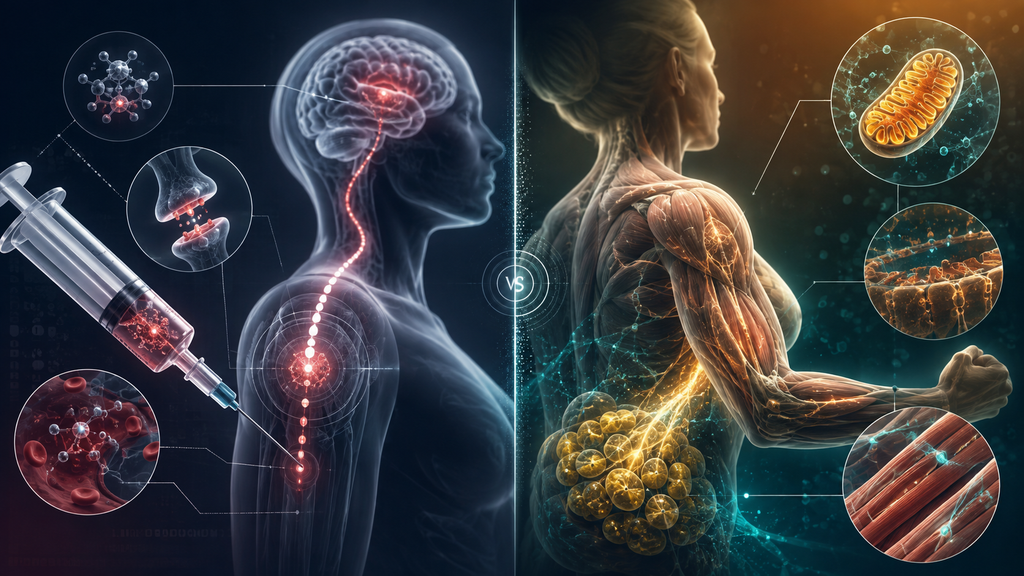
A direct argument from the source material contrasting appetite suppression with a metabolic-fueling approach centered on ketosis and stored-fat mobilization.
KEY TAKEAWAYS
- The article characterizes GLP-1 appetite suppression as a “quiet brain” approach.
- It frames ketosis as a metabolic fuel switch that mobilizes stored fat for energy.
- Muscle preservation is treated as a central metric in the comparison.
- The closing question asks readers to focus not on silencing hunger, but on how to “power the
machine.”
The pharmaceutical industry has sold the modern world a “quiet brain,” but at what cost to our metabolic machinery? We are currently witnessing a fever pitch obsession with appetite control, where the goal is no longer to nourish the body, but to effectively mute it. But as an investigative look into the physiology of weight loss reveals, there is a massive, hidden trade-off between simply stopping the sensation of hunger and actually fueling the human engine.
The central tension of the modern weight-loss era is this: Are we trying to achieve health, or are we merely seeking a chemical bypass for our appetite? While synthetic drugs promise a shortcut, the emerging data suggests we are choosing a path of deprivation over a path of efficiency.
The Reality of “Synthetic Starvation”
The meteoric rise of GLP-1 drugs has introduced a clinical method of suppression that functions by overriding the brain’s survival signals. These injections don’t fix a broken metabolism; they essentially trick the brain into believing it isn’t hungry so the patient stops eating. This is not a metabolic optimization-it is a state of synthetic starvation .
When the brain is forced to ignore hunger signals while the body remains in a state of energy crisis, the results are structurally devastating. This isn’t just about weight loss; it’s about a total deprivation of resources. This state of synthetic starvation is the direct culprit behind the “loose skin look” and rapid muscle atrophy that have become the hallmarks of pharmaceutical suppression. When the body isn’t supported during weight loss, it doesn’t just burn fat-it consumes itself.
“Your body is just being deprived of fuel.” Masking hunger is a high-stakes gamble. By using external chemistry to put a mask on the body’s natural signaling, we risk destroying the very metabolic tissue-our muscle-required to maintain health in the long term.
Ketosis: The “Natural GLP-1 Factory”
There is an alternative that doesn’t require a prescription or a needle: metabolic fueling through ketosis. While drugs force a signal from the outside in, ketosis works from the inside out by “switching gears” in the body’s internal engine. Instead of relying on a constant stream of external glucose, the body begins mobilizing its own stored fat for super-efficient energy.
This physiological shift creates what can only be described as the body’s own natural GLP-1 factory . In this state, the body isn’t being forced into silence; it is being transitioned into a higher state of efficiency. While a drug forces the brain to ignore the lack of fuel, ketosis actually fuels the cells by accessing the massive reservoir of energy stored in body fat. This is the difference between forcing a signal and changing the fuel source.
The Hollow Victory of Muscle Loss
In the world of metabolic health, muscle is the primary driver of metabolic vigor. It is the engine that burns calories, regulates glucose, and maintains structural integrity. This makes muscle preservation the only metric that truly matters-yet it is the very thing being sacrificed in the name of synthetic suppression.
Synthetic drugs, by inducing a state of starvation, often force the body to catabolize its own muscle tissue to survive the deficit. This is a hollow victory; a lower number on the scale is meaningless if you have destroyed your metabolic engine to get there. Conversely, metabolic support through fat mobilization is specifically designed for muscle preservation. Because the body has reliable, steady access to its own fat stores, it doesn’t need to tear down muscle for fuel. True health isn’t about eating less; it’s about ensuring the body has the reliable energy it needs to thrive.
The Verdict: Synthetic Suppression vs. Metabolic Support
The difference between putting a mask on hunger and truly supporting the body’s energy production is stark. One is a chemical bypass; the other is a metabolic upgrade. Feature Synthetic Suppression (GLP-1 Drugs) Metabolic Support (Ketosis) Primary Mechanism Forcing the brain to ignore hunger signals. Switching gears to mobilize stored body fat. Effect on Muscle Atrophy & Catabolization (The “Loose Skin” Look). Preservation & Vigor (Protects the metabolic engine). Energy Source External Deprivation (Synthetic Starvation). Internal Fat Mobilization (Super-efficient fuel). The Verdict A chemical mask that risks metabolic health. A natural factory that supports long-term energy.
A New Question for Your Health Journey
We are at a crossroads in the way we approach human wellness. We can continue to chase the “quiet brain” offered by pharmaceutical intervention, or we can look toward the biological gear-shift that turns the body into a self-sustaining energy machine. One path offers the illusion of health through deprivation; the other offers the reality of health through efficiency.
As you navigate the noise of the weight-loss industry, stop asking how to stop the hunger and start asking how to power the machine. Do you just want to eat less, or do you want to fuel better?
This PDF reproduces and reformats the supplied article content for Nutrient TV presentation. It does not add external research or independently verify the source claims.
Alan C. North
Sports Nutritionist, Nutraceutical Formulator & Nutrition Advocate
Alan C. North is a leading voice in clinical health media, specializing in the intersection of metabolic biochemistry and human performance. With over 15 years in the field, he bridges the gap between complex peer-reviewed research and actionable health broadcast journalism.